
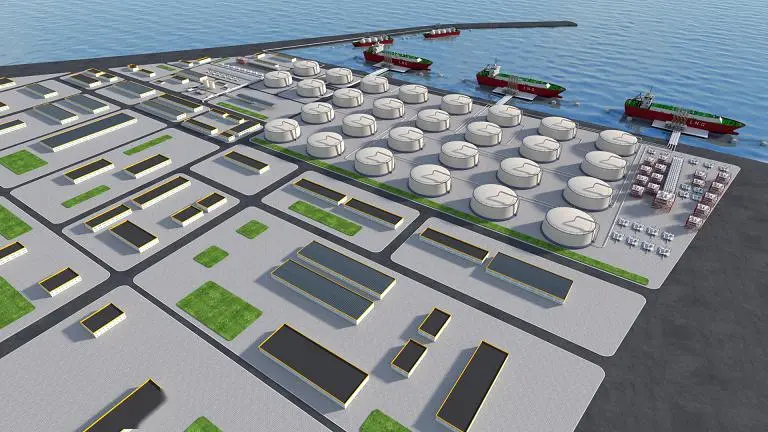
The Yantai LNG Terminal and Receiving Station Project (hereinafter referred to as the “Yantai LNG Project”), invested and developed by Shandong Poly GCL Huanya International Energy Co., Ltd., has recently received official approval from the National Development and Reform Commission (NDRC). Construction is scheduled to formally commence in April 2020.
The project developer, Shandong Poly GCL Huanya International Energy Co., Ltd., is a joint venture formed by three entities: Poly GCL Petroleum & Natural Gas (Yantai) Holdings Co., Ltd. (45%), Yantai Port Group Co., Ltd. (15%), and Shandong Huanya International Energy Distribution Center Co., Ltd. (40%).
The first phase of the Yantai LNG Project involves a planned investment of RMB 8.2 billion. It will include the construction of a 266,000-cubic-meter LNG unloading terminal, a 50,000-cubic-meter transshipment berth, five 200,000-cubic-meter full containment LNG storage tanks, associated regasification facilities, and a dedicated LNG port basin, channel, and anchorage. The terminal is designed with an annual LNG receiving capacity of over 5 million tonnes and a peak daily gasification capacity exceeding 40 million cubic meters. The project is expected to be completed and operational by 2022.
The second phase will involve the construction of two additional 266,000-cubic-meter berths and five more 200,000-cubic-meter LNG storage tanks. Upon completion, the terminal’s total LNG receiving capacity will exceed 10 million tonnes per year.
Complementing the terminal project is a long-distance natural gas pipeline, which is planned to be constructed and commissioned concurrently with the Yantai LNG facility. The pipeline will run approximately 530 kilometers from the Yantai West Port LNG Receiving Terminal to the Qihe Station, where it will connect with the national natural gas pipeline network. Designed with a diameter of 1,219 millimeters, the pipeline will have an annual transmission capacity of 23 billion cubic meters. The project represents an investment of approximately RMB 8.6 billion. Depending on market development, a parallel pipeline may be constructed along the same route in the future to meet the growing demand for natural gas in the region.
As a key national and provincial project, the Yantai LNG initiative is expected to benefit six cities and several industrial clusters across Shandong Province, serving a population of over 40 million. Once completed, it will significantly enhance the region’s natural gas supply and storage capabilities, facilitate a cleaner energy transition, support air pollution prevention, improve the ecological environment, and further drive local economic development.
Energy transformation and upgrading have become a strategic priority for China. Energy issues have reached an unprecedented level of national importance. By 2018, China had become the world’s largest importer of natural gas, with total imports exceeding 80 million tonnes. As the economy continues to grow, China’s demand for natural gas is expected to maintain double-digit growth. In response, the government is actively promoting the construction of LNG receiving terminals, natural gas pipelines, and other clean energy infrastructure, aiming to optimize the country’s energy mix and achieve its goals for energy conservation and emission reduction.
Looking ahead, the Yantai LNG terminal aims to develop into a public service platform, engaging upstream with international oil and gas giants and downstream with regional industrial enterprises and urban gas distributors. It will offer high-quality, efficient, “door-to-door” services, and strive to become a major energy distribution hub in northern China.

 Chinese
  English