
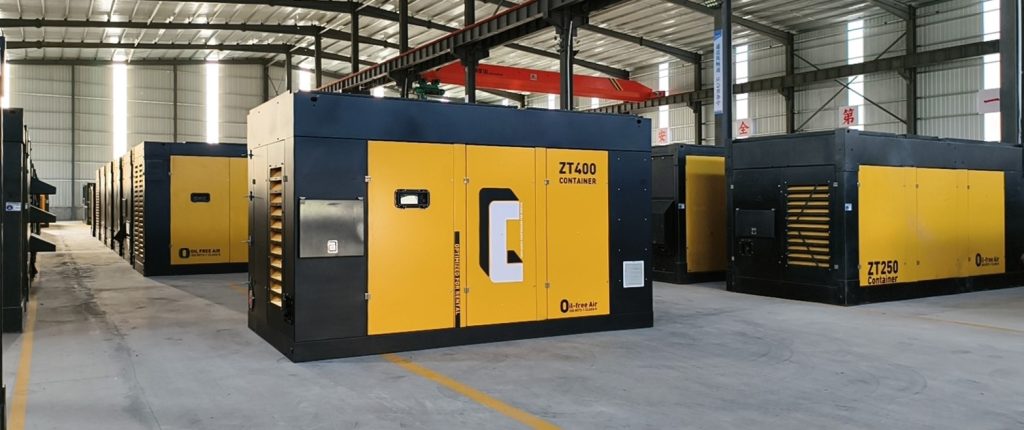
Precision Selection Enhances Efficiency and Optimizes Cost
Choosing the right air compressor model is critical for both the user and the equipment itself. Oversizing leads to wasted resources, while undersizing may cause the compressor to operate continuously under load, resulting in insufficient air supply, failure to reach the desired pressure, and ultimately reduced production efficiency and shortened equipment lifespan. So, how can one make a scientific and effective selection when renting an air compressor? Based on years of industry experience, FOOEN’s technical experts have summarized the following four key considerations:
1. Determining Air Discharge Volume: Proper Matching is Key
Air discharge volume is one of the most important technical parameters of an air compressor and must be matched to actual air consumption:
- If the air discharge volume is lower than actual demand, pneumatic tools or air-powered equipment may experience a rapid drop in pressure upon startup, resulting in operational failure.
- Choosing a model with excessively high capacity will increase procurement and energy costs, leading to unnecessary resource waste.
Scientific Calculation Method:
For general factories, the design air capacity Q₂ can be estimated using the formula:
Q₂ = ΣQ₀ × K × (1 + Φ₁ + Φ₂ + Φ₃) m³/h
Where:
- Q₂ = Designed air discharge volume
- ΣQ₀ = Total average air consumption across all usage points
- K = Uneven distribution factor (typically 1.2–1.4)
- Φ₁ = Pipeline leakage factor (0.1–0.2 based on pipe length)
- Φ₂ = Equipment wear factor (0.15–0.2)
- Φ₃ = Unforeseen air usage factor (approx. 0.1)
If the purification system includes a regenerative adsorption dryer, regeneration air consumption should also be factored in:
- Heated regeneration: Add approx. 8%–10%
- Heatless regeneration: Add approx. 15%–20%
For applications with significant fluctuations in air demand, it is recommended to use multiple small compressors in parallel, enabling flexible operation according to load, which improves both energy efficiency and stability.
2. Determining Discharge Pressure: Ensure Adequate Pressure and Stable Delivery
Proper discharge pressure is essential for reliable operation:
- Insufficient pressure margin during tool operation, especially with long air transmission distances, may result in pressure drops and insufficient terminal pressure.
- Pressure settings should account for both linear resistance in pipelines and local resistance caused by valves, tees, elbows, etc.
Reference Value:
For a transmission distance of 100 meters, pressure drop should be limited to 0.4 kg/cm² or less. If anticipated losses exceed this value, increase the design pressure of the compressor accordingly to ensure proper end-use operation.
3. Selecting the Cooling Method: Tailored to the Site, Balanced in Effectiveness
The two main types of air compressor cooling methods are air cooling and water cooling. Selection should be based on environmental and site conditions:
| Usage Scenario | Recommended Cooling Method |
|---|---|
| Confined spaces (e.g., onboard or marine use) | Vertical air-cooled |
| Highly mobile operations (moving >800 meters) | Mobile air-cooled |
| Outdoor work with no grid power | Diesel-driven air or water-cooled |
| No tap water supply | Air-cooled preferred |
Comparison: Air-Cooled vs Water-Cooled
- Air-Cooled: Simple structure, flexible installation, no need for water supply; accounts for over 90% of the global small compressor market. However, heat dissipation ducting and ambient temperature must be considered.
- Water-Cooled: Offers higher cooling efficiency and is suitable for large systems, but requires a complete water supply and drainage system. Higher capital and operating costs, and there’s risk of freezing in northern regions during winter.
4. High-Altitude Considerations: Altitude Correction to Ensure Performance
In plateau or high-altitude regions, reduced atmospheric pressure lowers intake air density, resulting in decreased output and increased motor load. Thus, compressor capacity and power must be corrected according to elevation.
Altitude Correction Factor Reference Table:
| Altitude (m) | Correction Factor |
|---|---|
| 0 | 1.00 |
| 305 | 1.03 |
| 610 | 1.07 |
| 914 | 1.10 |
| 1219 | 1.14 |
| 1524 | 1.17 |
| 1829 | 1.20 |
| 2134 | 1.23 |
| 2438 | 1.26 |
| 2743 | 1.29 |
In such environments, compressors with high volumetric efficiency and specialized motors are recommended to ensure continuous and stable air supply under low atmospheric pressure.
Conclusion
Air compressor selection is far from a trivial matter. It involves careful consideration of air volume, pressure, cooling method, and environmental adaptability. Proper selection enhances production efficiency, reduces operating costs, extends equipment lifespan, and minimizes downtime.
Adhering to its core philosophy of “Service Excellence, Long-Term Mutual Benefit,” FOOEN Rental offers a wide range of high-performance compressor rental equipment and a team of seasoned experts. We provide customized compressed air solutions for various industries and applications—powering your efficient production with confidence.

 Chinese
  English