
-中文-1024x576.jpg)
From numerous nitrogen generation operation and maintenance cases, it is evident that enterprises often focus primarily on equipment purchase costs when planning their nitrogen supply systems, while underestimating the uncertainty and downtime risks during operation. In practice, the main threats to production continuity do not come from the performance of the equipment itself, but rather from blind spots in stability management.
Especially in industries with stringent nitrogen quality and continuity requirements—such as food packaging, metal protection, chemical inerting, and lithium battery drying—the following four risk types are often overlooked. However, once they occur, the resulting losses usually far exceed the apparent maintenance expenses.
| Risk Type | Typical Consequence | Hidden Cost |
| Elevated dew point / purity fluctuation | Product oxidation, discoloration, rework | Production loss doubles with each hour of downtime |
| Insufficient or unstable pressure | Disruption of downstream processes | High-value equipment forced to shut down |
| PSA valve group failure | Frequent self-check alarms | Emergency bottled nitrogen required, sharply increasing cost |
| Membrane contamination | Sudden drop in nitrogen output | Production disorder, missed delivery deadlines |
Such losses cannot be fully avoided through routine self-checks or maintenance. The core issue lies in the lack of quantitative lifecycle risk assessment for the operation of nitrogen systems.
I. Three Hidden Risks in Self-Built Nitrogen Generation Systems
| Potential Issue | Superficial Cost | Essential Risk |
| Improper or excessive sizing | Equipment idle or undercapacity | Energy waste / performance bottlenecks cannot be adjusted |
| Uncontrolled failures | Third-party dependent repairs | At least 48-hour downtime—production cannot wait |
| Demand fluctuation mismatch | High fixed-asset investment | Insufficient capacity in peak seasons / idle capacity in off-seasons |
II. FOOEN Nitrogen Generator Rental: Beyond Equipment — It’s About Operational Assurance
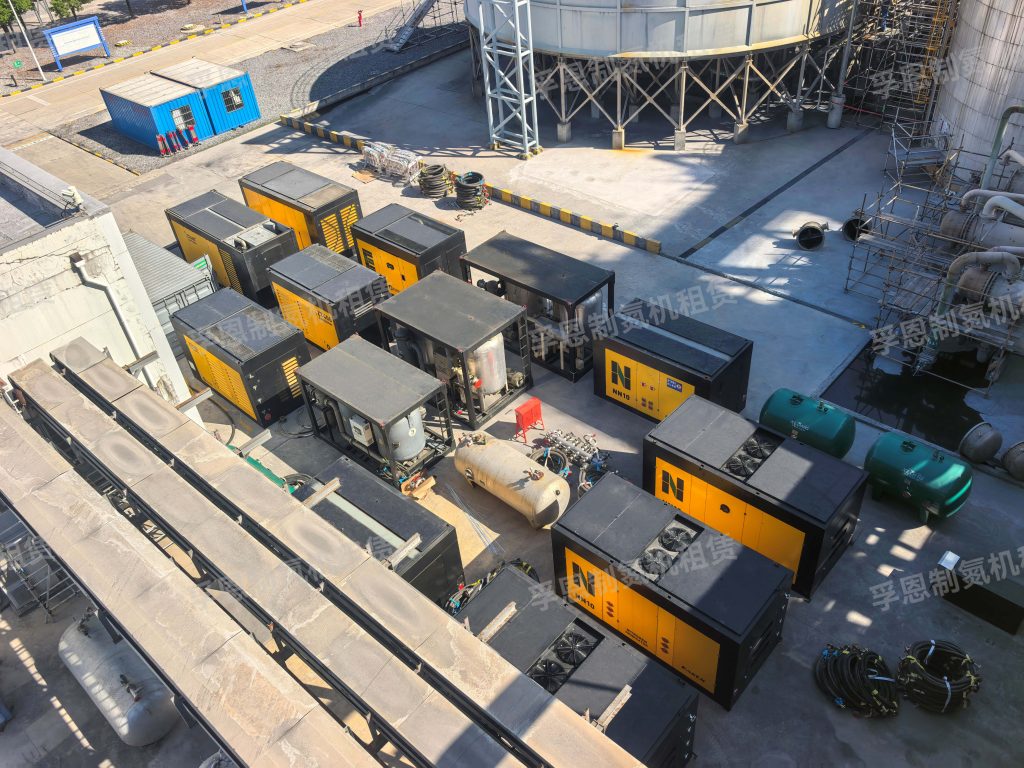
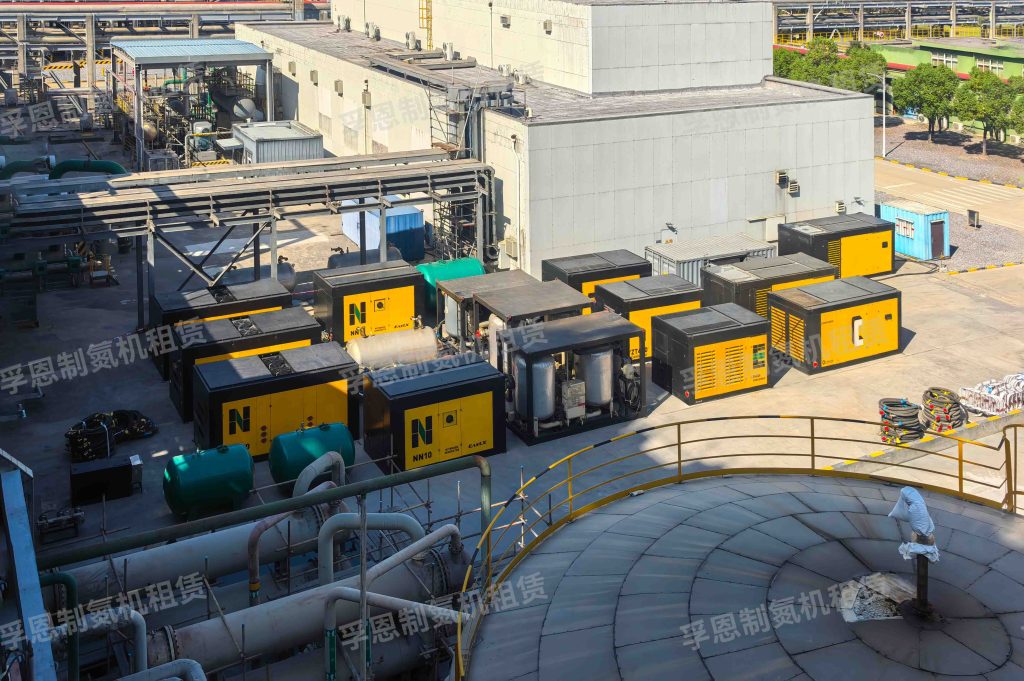
FOOEN provides not only nitrogen generators, but a complete, scalable, replaceable, and 24-hour backup nitrogen supply system, ensuring continuous and stable operation.
- Tailored PSA or membrane separation schemes based on working conditions
- Rapid parallel capacity expansion for high-load demands
- Immediate replacement upon failure to maximize production continuity
- Centralized nitrogen supply and pipeline distribution for multi-line operations
- Optional dew point monitoring and remote alarm systems to meet auditing and quality control requirements
Conclusion: Defining Nitrogen System Value Through Lifecycle Controllability
The investment value of a nitrogen generation system should not be evaluated solely by purchase cost, but by its controllability over the entire lifecycle.
Self-owned systems require enterprises to bear all uncertainty costs—such as sizing errors, downtime from failures, and load fluctuations—independently.
In contrast, the FOOEN RENTAL model transforms these risks into predictable, manageable service costs through professional diagnostics, on-demand configuration, and an instant replacement mechanism.
In pursuit of production continuity and operational resilience, the real question is not “Which is cheaper—buying or renting?”, but rather “Which costs are controllable, and which are not?”

 Chinese
  English